RadClerk Recognized at 2026 UCLA Nursing Science and Innovation Conference
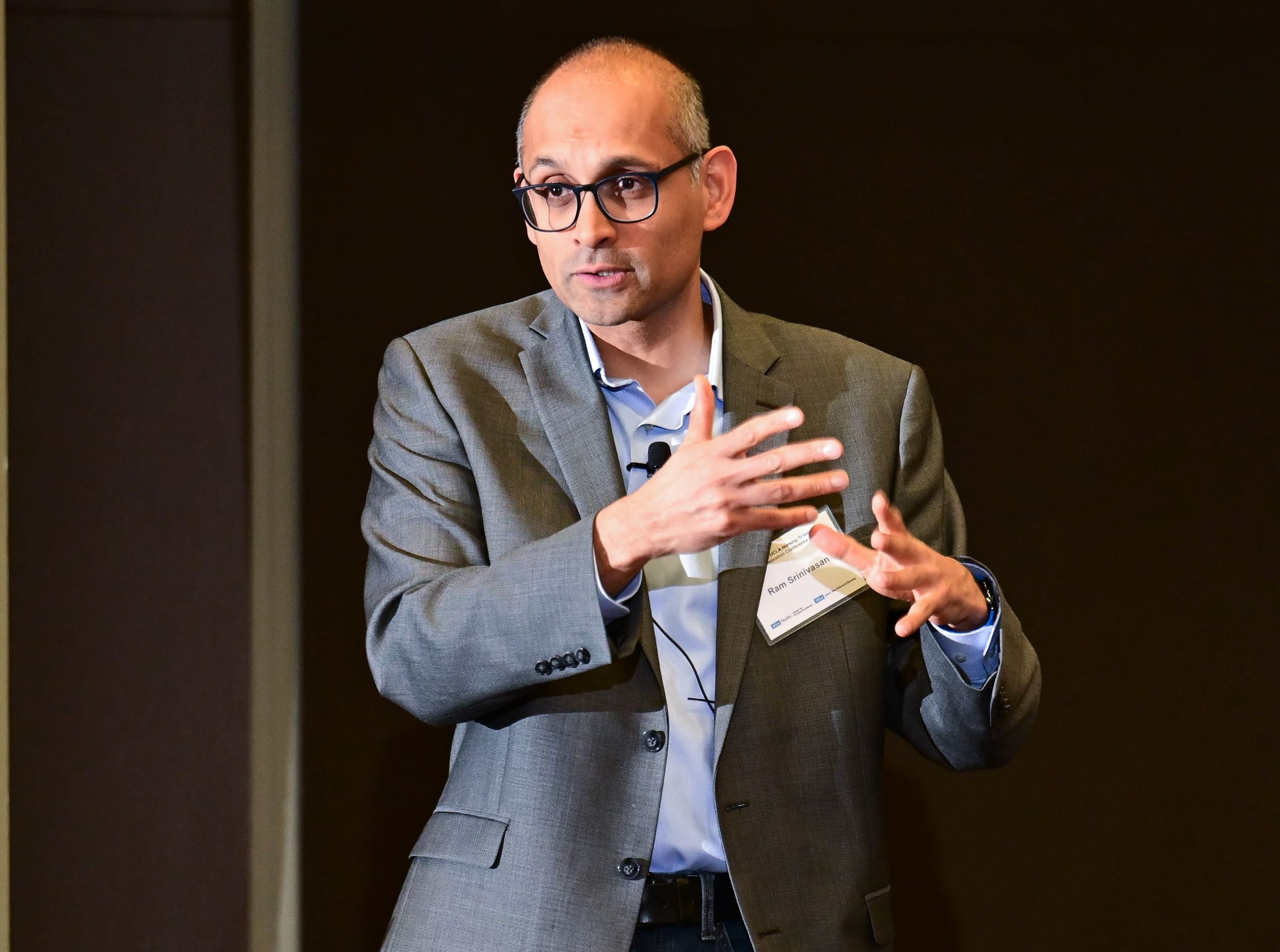
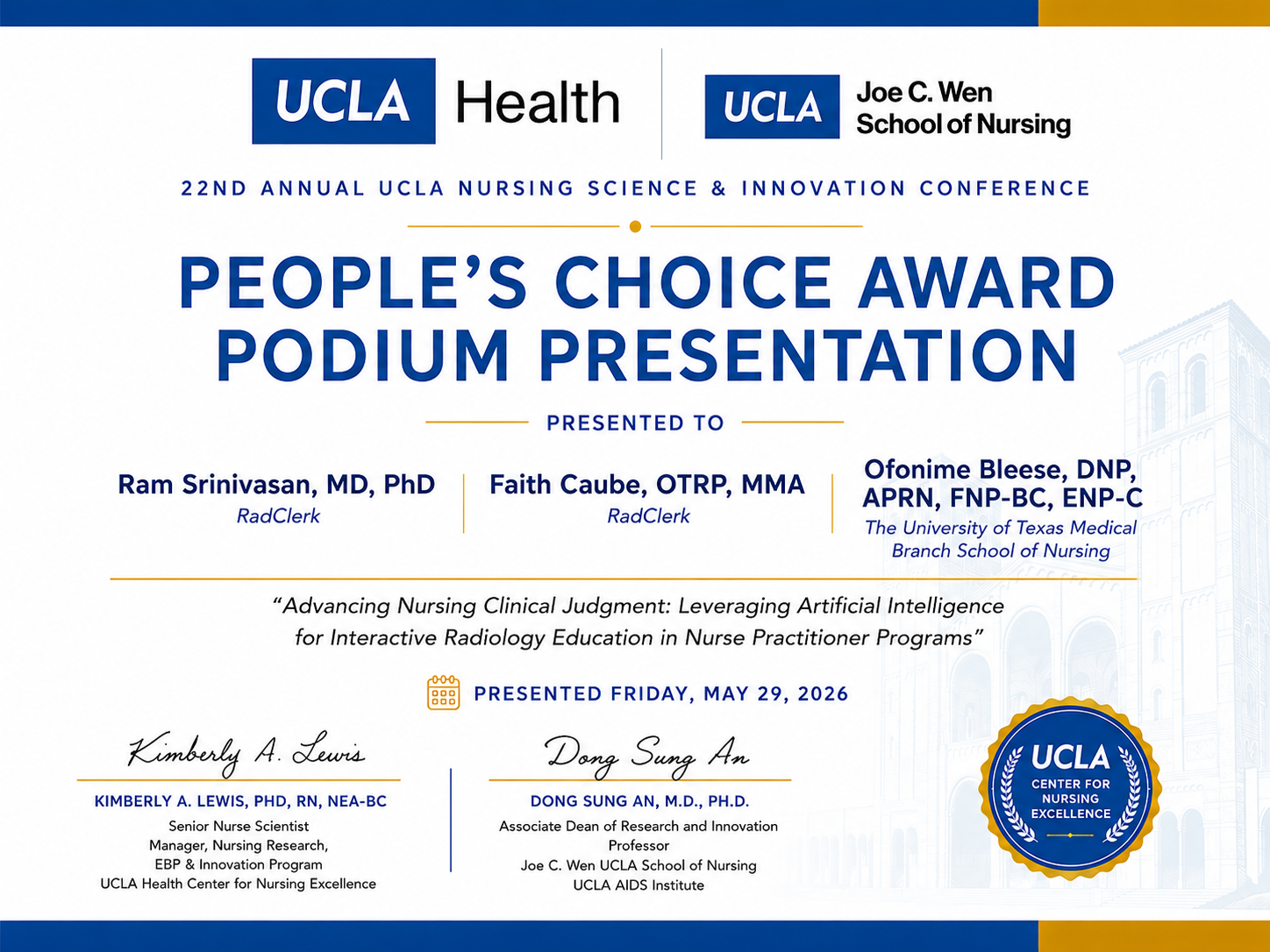
Los Angeles, California — RadClerk is honored to share that Ram Srinivasan, MD PhD, Faith Deanne Mari Caube, OTRP, MMA, and Ofonime Bleess, DNP, APRN, FNP-BC, ENP-C were selected by conference attendees as the best podium presentation at the 2026 UCLA Nursing Science and Innovation Conference.
Their presentation, “Advancing Nursing Clinical Judgment: Leveraging Artificial Intelligence for Interactive Radiology Education in Nurse Practitioner Programs,” focused on a timely question for nursing education and clinical practice: How can AI help students build real clinical judgment, while preserving the expertise, accountability, and human guidance that healthcare education requires?
That question was central to the conference itself. The morning session focused intensively on the use of AI in nursing education and practice, with talks spanning AI-enabled student research, clinical judgment, machine learning models for postoperative symptom prediction, and AI-supported radiology education for nurse practitioner programs.
The session also featured a keynote from Maxim “Max” Topaz, PhD, RN, MA, FAAN, FACMI, FIAHSI, Elizabeth Standish Gill Associate Professor of Nursing at Columbia University Medical Center, titled “The Safeguard That Has Not Been Built Yet: AI in Nursing and the People Who Make the Difference.”
Dr. Topaz addressed one of the most urgent issues in AI and healthcare scholarship: the need for safeguards as AI-generated content enters professional and academic workflows. His recent work in The Lancet on fabricated references in peer-reviewed biomedical publications underscored why AI literacy, verification, and human oversight are no longer abstract concerns.
But one of the most important educational take-homes from his keynote was not simply that AI can make mistakes. It was that AI should not short-circuit student learning.
In health professions education, the goal cannot be to let AI give students the answer faster. The goal is to help students think better. Dr. Topaz emphasized that AI should preserve the productive struggle students need in order to develop judgment, rather than bypassing that struggle with premature answers.
That philosophy has been central to RadClerk from the beginning.
RadClerk is designed not as an answer engine, but as a Socratic teacher. Learners are asked to look carefully, commit to an interpretation, compare findings, revise their thinking, and explain what they see. The AI feedback is there to guide, prompt, and coach — not to replace the learner’s reasoning process.
That made the setting especially meaningful for RadClerk.
Scaling the kind of teaching that usually happens at the workstation
Radiology training has traditionally depended on high-touch apprenticeship.
Learners review real cases, commit to an interpretation, receive expert feedback, and gradually build judgment through repetition. In radiology residency, that often happens at the workstation: a learner reviews a case, offers a preliminary read, and then works through the image with a faculty radiologist who can ask questions, point out missed findings, and help refine the learner’s mental model.
That model is powerful.
It is also difficult to scale.
Most nurse practitioner students, PA students, medical students, and other non-radiology learners do not have daily access to radiology attendings at a clinical workstation. Yet many will practice in settings where chest radiographs, CT scans, and ultrasound findings influence triage, diagnosis, and management.
RadClerk was built to help close that gap.
Since launching in 2023, RadClerk has combined clinical-grade radiology cases, a real image viewer, and AI-supported feedback to help learners practice the process of interpretation rather than simply memorize findings. To date, RadClerk has graded more than 100,000 learner dictations across more than 500 curated cases.
The goal has never been to replace faculty.
The goal is to make more expert-guided practice possible.
Evidence from nurse practitioner education
The UCLA presentation highlighted collaborative work with UTMB School of Nursing, where more than 100 nurse practitioner students participated in RadClerk-based instruction.
After a single RadClerk session focused on chest radiography, students demonstrated a statistically significant improvement on a visual diagnosis assessment. The median score increased from 4 to 6 out of 10, representing a 50% lift in median assessment score.
For learners who often have limited formal training in chest x-ray interpretation, that improvement is meaningful. It supports the idea that case-based learning, guided by AI and anchored in radiology expertise, can help students build practical visual diagnostic skills.
It also reinforces a broader educational point: clinical judgment is built through practice.
Learners need to see many cases. They need to make decisions. They need to receive feedback. They need to encounter uncertainty. And they need opportunities to improve before they are responsible for those decisions in clinical care.
Introducing Interactive Cases
At the conference, the RadClerk team also announced the launch of Interactive Cases, a new learning experience designed to move beyond automated grading.
The original RadClerk experience asked learners to review a study, submit a preliminary interpretation, and receive feedback. Interactive Cases add a more guided layer: the RadClerk Copilot can help learners navigate the image, recognize relevant anatomy, localize findings, and reason toward the diagnosis step by step.
Importantly, Interactive Cases are not designed to simply reveal the answer.
They are designed to preserve the learner’s work of noticing, comparing, localizing, and deciding. The Copilot can ask learners what stands out, direct their attention to the right region, and help them test their interpretation against the image.
This is an important shift. Instead of only evaluating a learner’s final answer, RadClerk can now support the process of getting there.
That matters because clinical judgment is not just about naming an abnormality. It involves knowing where to look, deciding what matters, comparing sides, recognizing uncertainty, and connecting imaging findings to patient care.
We will share more soon in a dedicated post focused specifically on Interactive Cases.
What AI cannot replace
During the discussion, one audience member asked Ram Srinivasan what he had learned from three years of building and teaching through RadClerk.
His answer was simple: the core of education is still the emotional connection between teachers and students.
AI can scale feedback. It can create more opportunities for practice. It can help learners work through cases when a faculty member is not available. But the reason students keep going — especially when the material is difficult — is that they feel guided, encouraged, and seen by humans that care about them.
That insight has shaped RadClerk’s approach to AI education. The goal is not to make learning feel automated. The goal is to make high-quality teaching more available, while preserving the encouragement, challenge, and trust that define effective instruction.
In that sense, AI is most useful when it helps extend the teacher’s presence, not erase it.
AI in nursing education is becoming a practical question
One of the strongest themes of the conference was that AI is no longer a distant topic for nursing education. It is already affecting how students search the literature, how clinicians interact with decision support, how researchers analyze data, and how educators think about clinical judgment.
The podium sessions reflected that breadth.
In the morning AI-focused session, presentations addressed AI-enabled student research, clinical judgment, machine learning models for postoperative dyspnea prediction, and the use of interactive radiology education in nurse practitioner programs. Other sessions throughout the day focused on patient safety, nurse–physician communication, OR-to-ICU handoffs, nursing-led hemorrhage control, workforce modeling, clinical readiness, EHR alerts, health equity, chronic disease, neuroscience, mindfulness, and quality improvement.
In the afternoon session, Ram Srinivasan, MD PhD, together with UCLA Nursing leader Kimberly Lewis, PhD, RN, NEA-BC, presented “What is the Future of Nursing School Admissions?”, featuring a fundamental analysis of the conceptual approach behind Meshwell (meshwell.ai), a platform focused on trusted AI workflows for admissions in nursing programs, PA schools, and medical schools.
That discussion complemented the RadClerk presentation by focusing on a different but equally important part of the educational pipeline: how nursing programs can evaluate applicants fairly, consistently, and responsibly in an era of AI, while preserving the human role at the center of this critical process.
Across these sessions, the message was clear: nursing education does not need AI for its own sake. It needs thoughtful tools that help faculty teach, help learners practice, and help institutions make better decisions while preserving trust.
Radiology education for the broader healthcare workforce
RadClerk’s mission is not limited to radiology residents. While early-stage radiology trainees benefit from structured case practice, the need is much broader.
Nursing students, nurse practitioner students, PA students, medical students, CRNAs, and other healthcare professionals increasingly work in environments where imaging is part of everyday decision-making. They do not need to become radiologists. But they do need enough imaging fluency to recognize urgent findings, communicate effectively, and make safer clinical decisions.
That is especially important in settings where clinicians may be the first to review an image, communicate with a patient, triage urgency, or decide whether additional evaluation is needed.
The UCLA Nursing Science and Innovation Conference was a fitting setting for this conversation. Nursing education has always adapted to meet the needs of patients, communities, and evolving models of care. AI-powered learning creates a new opportunity to expand access to expert-guided practice, especially in clinical domains that have historically been difficult to teach at scale.
A shared recognition
Congratulations to:
Ram Srinivasan, MD PhD
RadClerk Course Director
Faith Deanne Mari Caube, OTRP, MMA
RadClerk Learning Designer
Ofonime Bleess, DNP, APRN, FNP-BC, ENP-C
UTMB School of Nursing Faculty
We are grateful to UCLA Nursing for hosting a thoughtful conference on nursing science and innovation, to UTMB School of Nursing for its collaboration, and to the students who continue to help us understand how AI can be used responsibly in health professions education.
We are also grateful to the conference attendees who selected the RadClerk presentation for this recognition.
RadClerk began with a simple educational idea: learners improve when they practice on real cases and receive expert feedback.
The next step is making that experience more interactive, more accessible, and more useful for the clinicians who will carry imaging knowledge into patient care.